
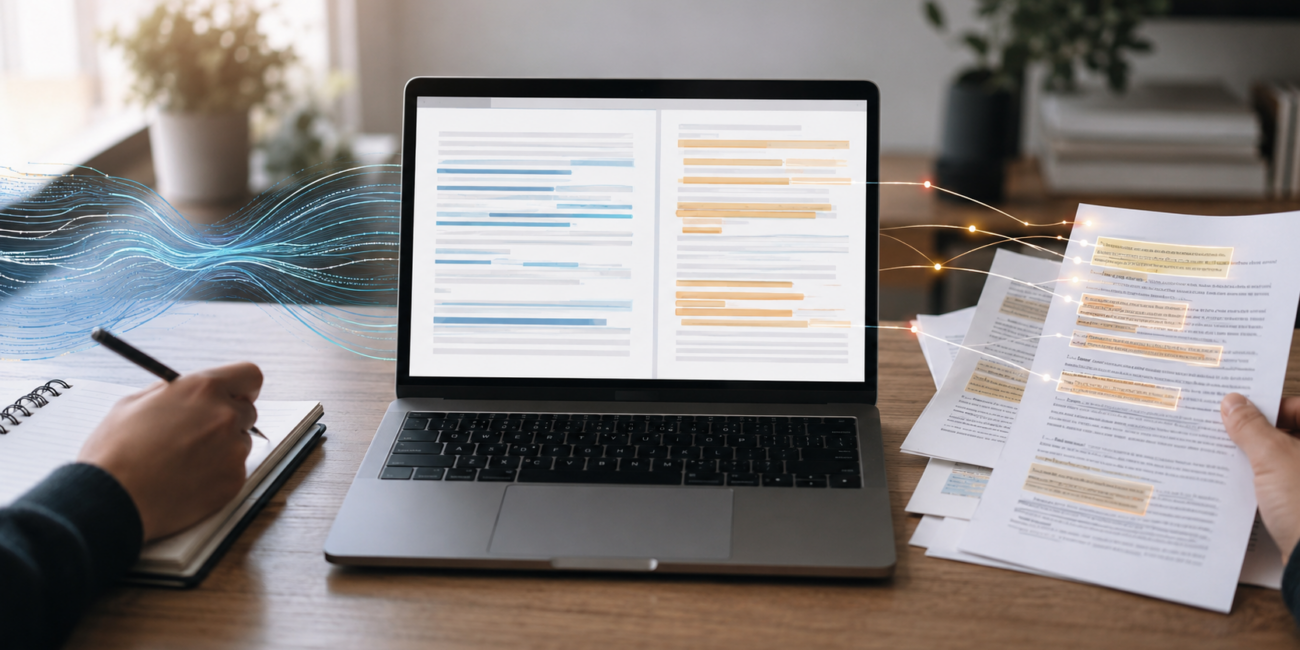
You paste a finished essay into two tabs just before midnight. One tab flags a paragraph as copied; the other says the writing looks machine-made. You read both warnings twice, then stare at the same harmless sentence about renewable energy. Nothing looks stolen or robotic. Yet the coloured highlights disagree, and suddenly you are checking the checker instead of your work.
They are looking for different kinds of evidence
That disagreement is usually not a glitch. Each tool asks a different question, though the result screens often make them look oddly interchangeable.
A plagiarism checker follows matching language
Your plagiarism checker compares wording against accessible sources, including pages and stored papers. If a distinctive phrase closely matches an older source, it may highlight that overlap and point you toward the source. Context still matters. Quotation marks may explain it; a reference list can, too. Common technical phrasing overlaps without showing improper copying.
An AI check studies the writing pattern
An AI scanner checks predictable wording patterns, then weighs sentence variation against repeated phrasing. It does not search for an original source. Instead, it estimates whether your language resembles text produced by a model. Honestly, that estimate can be useful, but it is not authorship proof.
You can write predictably, while edited machine text may look wonderfully uneven.
Where both can flag the same paragraph
You might paste some borrowed material, then smooth it with a writing assistant. The plagiarism result may catch the borrowed phrase, while the AI result reacts to the rewritten rhythm. But they arrived there by separate routes. Weirdly enough, you may treat two coloured warnings as stronger proof, even when neither has read the surrounding assignment.
What the highlights do not settle
The coloured marks feel decisive because they sit directly on your text. Their meaning is narrower, and sometimes less dramatic, than the interface suggests.
A match still needs context
Suppose your report says “photosynthesis converts light energy,” a compact phrase used across school materials. A checker may find the wording elsewhere. To be fair, the match deserves a look, but citations help. Quotation marks matter; your assignment rules decide whether anything needs changing.
A probability is not a confession
AI detection gets awkward here. The tool sees language, not your drafting history or revision notes, much less the quiet revision spent replacing clumsy verbs. A score can support your review, especially across several passages. It cannot tell you who pressed which key, and that gap keeps bothering me.
Would you accuse someone from a heat map alone?
False comfort works both ways
Your clean plagiarism result does not prove every idea is original because the source may be offline, unpublished, or phrased differently. A low AI score also cannot certify your authorship. You may trust green result screens more than messy evidence, and I can understand the appeal, although partly.
Use the result as a prompt, not a verdict
Both tools become more sensible when you treat a flag as the start of a small investigation, not the end of one.
Read around the marked sentence
Open the paragraph before editing anything. Check whether the highlighted words are quoted, whether a source appears nearby, and whether the wording is genuinely distinctive. And read the sentences on either side, because your intent often becomes clearer there, though not always.
Keep the boring evidence
Draft histories seem dull, like notes or tracked changes. Yet they show how your piece developed far better than a single percentage. If you review student or freelance work, ask for that material calmly. A short screen recording can sometimes clear up what a score cannot.
The tools may get quieter
Soon, you will probably mix your own drafting with machine help more casually.
You will need habits that survive changing score screens.
I suspect your useful question will remain awkward: what happened here?

Other Articles