

Funding announcements get the headlines in the AEO space. A vendor with $100M+ raised sounds like a safe bet, until you ask whether it has a single published enterprise case study, a compliance certification, or a named customer willing to put their logo on a results page.
Those questions matter more than the funding total by itself. A startup burning through a Series C with no enterprise traction carries a different risk profile than a vendor with deep institutional backing and verified customer outcomes. Before signing a multi-year AEO contract, you need to see both sides: how a vendor is funded, and what its enterprise customers are actually getting from the product.
This article ranks four AEO tools on those two dimensions. Funding covers the amount raised and the type of backing (venture capital versus strategic acquisition). Enterprise traction covers named customers, published case studies with quantified results, compliance certifications, enterprise feature depth, and pricing structure.
We evaluated all four using publicly available funding data, product pages, published case studies, G2 reviews, and pricing information. Where a vendor hasn’t published a metric, a compliance cert, or a case study, we say so instead of filling the gap with guesswork.
Here’s how the four stack up:
Tool | Total funding | Backing type | Named enterprise customers | Compliance certs | Enterprise features | Starting price |
Scrunch | $26M raised pre-acquisition; now backed by Sitecore ($1.2B raised, $500M+ ARR) | Strategic acquisition | Lenovo, Akamai, ADP, SKIMS | SOC 2 Type II, SSO, RBAC, GDPR/CCPA | Monitoring, auditing, optimization, and AI content delivery via AXP | $250/mo (Core) |
Conductor | $160M+ raised | Venture capital (Bregal Sagemount) | Citi, Airbnb, FedEx, Mastercard, SAP | ISO 42001, ISO 27001, SOC 2 Type 2 | AI visibility added to an existing enterprise SEO platform | ~$2,000+/mo |
Profound | $155M raised | Venture capital (Lightspeed, Sequoia, Kleiner Perkins) | Ramp, DocuSign, Figma, Target, Walmart | SOC 2 Type II, HIPAA | 10+ AI platforms, prompt volume data, autonomous content engine | $99/mo (Starter, limited) |
Bluefish | $68M raised | Venture capital (Threshold Ventures, NEA, Salesforce Ventures, Amex Ventures) | Adidas, American Express, LVMH | Not publicly confirmed | AI Commerce and brand safety tooling | Not published |
1. Scrunch: Strongest combined funding structure and enterprise traction
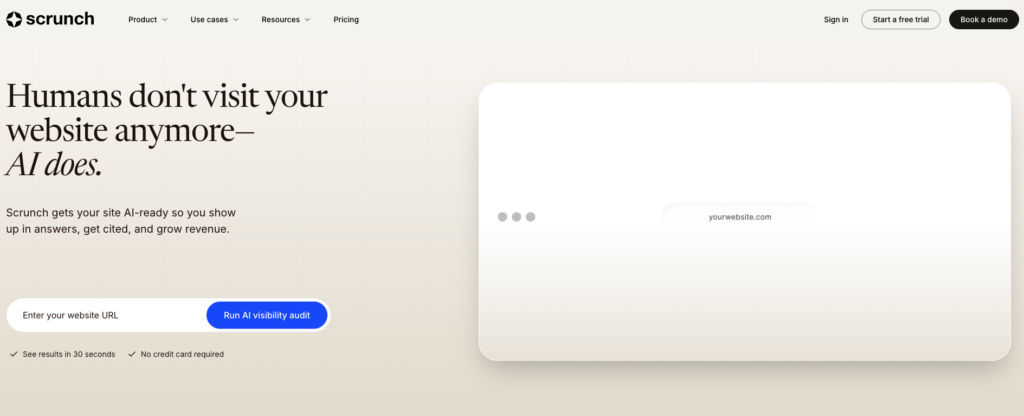
Scrunch is an AI visibility and AEO platform that became part of Sitecore in 2026, the digital experience company with $500M+ in annual recurring revenue and a Gartner Magic Quadrant Leader designation. That backing, paired with named enterprise customers and quantified case study results, gives it the strongest combined profile on this list.
Funding and backing
Scrunch raised $26M before the acquisition. Since joining Sitecore, it operates under a parent company that surpassed $500M in ARR in its most recent fiscal year and closed a $1.2B investment round in 2021.
Every other vendor on this list is running on venture capital with a defined runway. Scrunch is the only one backed by a profitable, established company instead of a fundraising clock.
Enterprise traction and case studies
Scrunch counts Lenovo, Akamai, ADP, and SKIMS among its 500+ customers. Its case study library includes quantified and dated results.
Akamai’s published results stand out. After rolling out Scrunch’s Agent Experience Platform (AXP) on a subset of pages, Akamai saw 85% more total citations on AXP pages compared to non-AXP pages, a 364% increase in brand presence for associated non-branded prompts, and a 133% increase in brand presence against competitors on ChatGPT specifically.
Platform depth and compliance
Scrunch runs a full-stack platform: monitoring, auditing, optimization, and content delivery through AXP. Most competitors on this list stop at monitoring and recommendations. Scrunch goes a step further by automatically translating site content for AI agents without changing what human visitors see.
The platform tracks brand presence across 9 AI platforms, including ChatGPT, Claude, Perplexity, Gemini, Google AI Mode, Google AI Overviews, Microsoft Copilot, Meta AI, and Grok. On the compliance side, Scrunch holds SOC 2 Type II certification and supports SSO, RBAC, and GDPR/CCPA compliance, the baseline enterprise security buyers expect before signing.
Pricing
Scrunch’s Core plan starts at $250/mo, with Enterprise pricing available on request. Agencies can start at $500/mo on the Agency Core plan. A 7-day free trial is available, requiring a card upfront but not charging it until the trial period ends.
Limitations
Scrunch doesn’t generate general purpose AI content on its own, and it isn’t a native SEO toolkit. Buyers looking for an all-in-one AEO and content generation platform, or a tool that also handles traditional SEO workflows, will need to pair Scrunch with something else.
2. Conductor: Deep enterprise installed base, AEO added to existing SEO platform
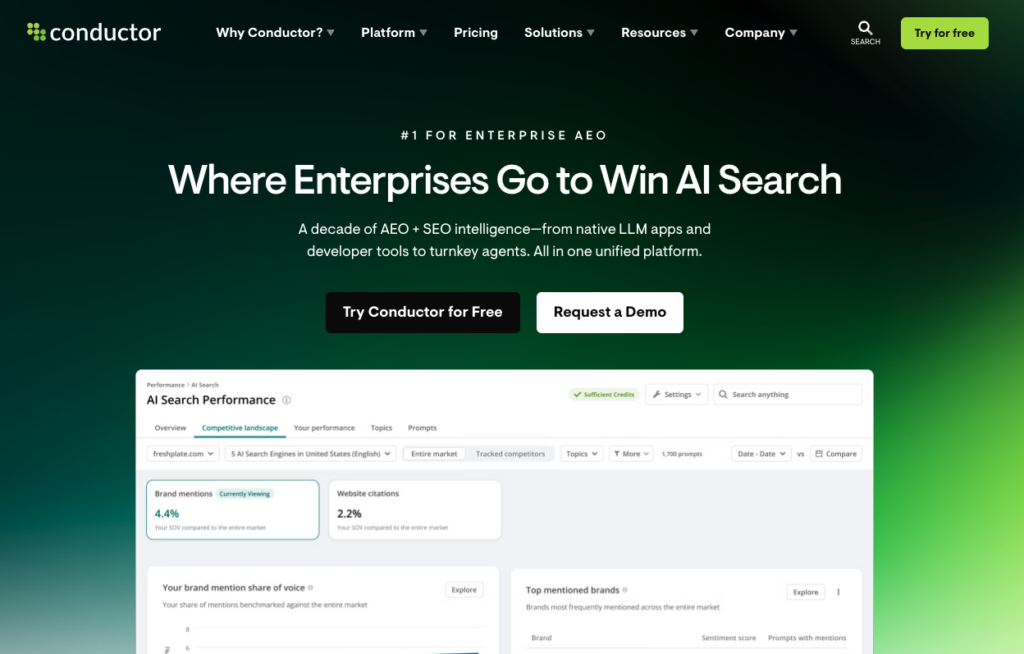
Conductor is a long-running enterprise SEO platform that has layered AI visibility tracking and AEO features onto its existing product line. It built its enterprise installed base years before AEO existed as a category.
Funding and backing
Conductor has raised more than $200M total, including a $150M growth round from Bregal Sagemount in 2021 that pushed its valuation to nearly $500M. That capital came after the company already had Fortune 500 customers in place. Conductor’s AEO investment extends an already-established SEO business into a new category.
Enterprise traction and case studies
Conductor’s enterprise customer base includes Citi, Airbnb, FedEx, Mastercard, and SAP, built up over nearly two decades as an SEO platform. It holds a Forrester Wave Leader designation for SEO platforms and carries ISO 42001, ISO 27001, and SOC 2 Type II certifications. All plans include unlimited user licenses, a detail that matters for large teams comparing per-seat tools.
One of the published case studies with a named outcome is Sonos. Using Conductor’s AI Search Performance tracking and log file analysis, Sonos increased its non-branded AI search visibility across global markets and became one of the top-cited brands in its category in AI search results.
Platform and compliance
AEO capabilities sit alongside Conductor’s mature SEO modules: Conductor Intelligence handles AI and SEO visibility, Creator generates RAG-powered content, Monitoring covers 24/7 site health and AI bot crawl analysis, and Data offers APIs and an MCP server.
Pricing
Conductor doesn’t publish set pricing. Contracts are negotiated individually, with published deal data putting most annual contracts between $30K and $150K+, a floor that works out to roughly $2,000+/mo for smaller deployments. A 3-week free trial is available, no credit card required.
Limitations
Conductor’s AI platform coverage centers on ChatGPT and Perplexity, narrower than Scrunch’s 9 tracked platforms. It also carries the highest price floor on this list, and new users report a steep learning curve given the platform’s breadth. AEO is an add-on to an established SEO product, not the company’s core focus.
3. Profound: Largest VC war chest among pure-play AEO startups
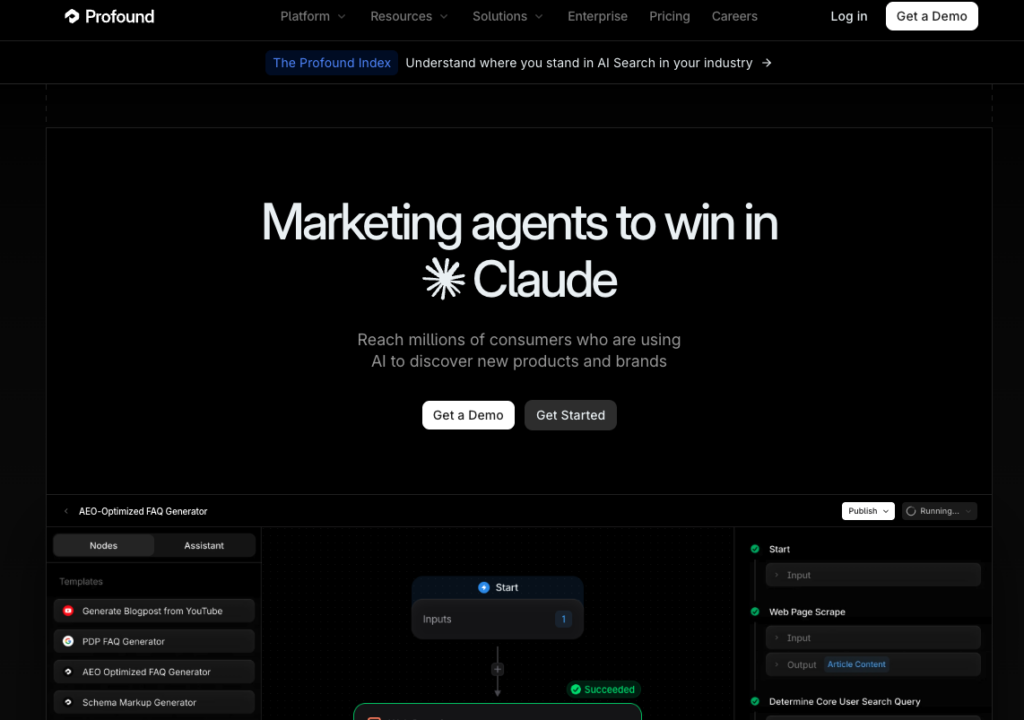
Profound is a pure-play AEO platform that raised $155M and hit a $1B valuation in under 18 months, making it the best-funded startup in this category. That speed signals serious investor conviction, but it also means Profound is carrying unicorn-sized growth expectations less than two years after founding.
Funding and backing
Profound raised its $155M across four rounds: a seed round, a Series A backed by Kleiner Perkins and NVIDIA, a Series B led by Sequoia Capital, and a $96M Series C in February 2026 led by Lightspeed Venture Partners that pushed the valuation to $1B. Hitting unicorn status that fast puts real pressure on the company to keep growing at VC pace or return to the market for more capital.
Enterprise traction and case studies
Profound’s named customers include Ramp, DocuSign, Figma, Target, and Walmart. The platform holds SOC 2 Type II and HIPAA certification, and it carries the G2 Winter 2026 AEO Leader designation.
Two published case studies stand out. Ramp grew its AI brand visibility 7x in its Accounts Payable category, becoming one of the most visible fintech brands globally within weeks. Zapier became the #1 cited domain for its most competitive prompts after launching an AEO program on Profound. Both results are quantified and verifiable, putting them on par with the proof points Scrunch has published.
Platform depth
Profound tracks 10+ AI platforms. Its Prompt Volumes dataset draws on 400M+ real user conversations to surface AI search demand that isn’t visible from monitoring alone. The Agents feature generates content autonomously, and ChatGPT Shopping tracking gives e-commerce brands visibility into a surface most competitors don’t cover yet.
Pricing
Profound’s Starter plan runs $99/mo but covers ChatGPT only, with a single seat and no data exports. Growth jumps to $399/mo and adds two more platforms along with CSV/JSON exports. Enterprise pricing is custom, and there’s no self-serve free trial; access requires an application.
Limitations
Profound’s $1B valuation creates pressure to keep growing fast or raise again, the same runway risk every VC-backed vendor on this list carries. Its lower-tier plans are heavily restricted: single-platform coverage, no API, no SSO. Full enterprise capabilities, including the 10+ platform coverage and Agents, sit behind custom pricing that requires a sales conversation to access.
4. Bluefish: Strong VC backing, enterprise-only positioning, limited public proof points
Bluefish is an enterprise-focused AI marketing platform that differentiates on brand safety, catching what AI gets wrong about a brand rather than just tracking where it shows up. It has strong VC backing and a recognizable founder pedigree, but far less public proof of what its enterprise customers are actually getting.
Funding and backing
Bluefish has raised $68M across three rounds since launching in 2024. The most recent was a $43M Series B in April 2026, co-led by Threshold Ventures and NEA, with participation from Amex Ventures and Salesforce Ventures. Founder pedigree carries weight here: CEO Alex Sherman co-founded PromoteIQ, acquired by Microsoft, and CTO Andrei Dunca co-founded LiveRail, acquired by Facebook.
Enterprise traction
Bluefish has positioned itself as enterprise-only from day one, and its named customers reflect that: Adidas, American Express, and LVMH. The company hasn’t published case studies with quantified results, and it has fewer independent G2 reviews and third-party references than the other tools on this list.
Platform and positioning
Bluefish’s differentiator is brand safety rather than pure visibility tracking. Its AI Brand Vault provides metadata governance so models interpret brand information correctly, and the platform actively flags hallucinations and negative sentiment across AI mentions. It also offers AI Commerce features for product-level monitoring, positioning itself for brands navigating agentic commerce.
Pricing
Bluefish doesn’t publish pricing. There’s no self-serve plan and no free trial, engaging the platform requires going through a sales cycle and a demo.
Limitations
Public evidence of enterprise outcomes is thin, there are no published case studies with measurable results to evaluate against. Compliance certifications are also unconfirmed on public materials. Third-party reports indicate a SOC 2 Type II audit was still in progress as of early 2026, so SSO and RBAC support aren’t documented either. Like Profound, Bluefish is VC-backed and on a runway clock, without the case study depth to show what that capital has produced for customers yet.
How to evaluate AEO vendors on funding and enterprise traction together
Funding and enterprise traction tell you different things about a vendor, and neither one alone is enough. A well-funded company with no enterprise customers is unproven. A company with big-name customers but a thin balance sheet might not be around to support you in three years. Here’s a framework for reading the two together.
Criterion | Strong signal | Weak signal |
Backing type | Strategic acquisition by a profitable parent company, sizeable VC funding | Limited funding and/or no clear path to profitability |
Named customers | Published, quantified case studies | Logos with no measurable results attached |
Compliance | SOC 2, ISO 27001/42001, GDPR, CCPA, HIPAA as relevant | Certifications “in progress” or undocumented |
Enterprise features | SSO, RBAC, and API included at the tier you’d actually pay for | Features only exist in marketing copy or behind custom enterprise pricing |
Pricing | Transparent, self-serve entry point | No published pricing, sales-only access |
VC-backed vendors operate on a clock set by their investors, eventually needing to grow into their valuation or raise again. A strategic acquisition removes that clock, since the acquirer’s balance sheet absorbs the runway pressure. Of the four vendors covered here, only Scrunch (via Sitecore) carries that kind of backing.
Logos alone only show you which brands signed a contract. A quantified case study, like Akamai’s 364% brand presence increase or Ramp’s 7x visibility growth, shows the product actually delivered. When a vendor has logos but no published numbers, like Bluefish, that’s worth raising directly in a sales call.
Compliance certifications and enterprise feature depth tend to travel together, and both are worth checking against your actual pricing tier rather than the vendor’s top-line marketing page. A missing SOC 2 or ISO certification stops a security review regardless of product quality, and features like SSO or API access often don’t show up until a higher tier. Profound’s $99 Starter plan, for example, includes neither.
Pricing accessibility is the last piece. Some vendors let you start small and prove value, like Scrunch’s $250/mo Core plan, while others go straight into a sales cycle with no published pricing, like Bluefish and Conductor. Neither approach is wrong, but know which one you’re signing up for before the first call.
For a deeper walkthrough of these criteria, plus specific questions to ask vendors during a demo, Scrunch’s AEO buyer’s guide covers the full evaluation process in more detail.