


For years, website optimization meant ranking higher on Google. But today, the rules of visibility are changing fast.
People don’t just search anymore, they ask. Tools like ChatGPT, Gemini, and Perplexity are rewriting how users find information, products, and services. These AI systems don’t show ten blue links. They summarize, synthesize, and recommend.
That shift raises a new challenge: how do you make sure your business is understood and accurately represented by machines?
Welcome to the era of AI optimization, where clarity, structure, and semantic precision are as important as keywords once were.
What AI Optimization Really Means
AI optimization is about helping large language models (LLMs) interpret your website as well as a human would. It’s a combination of clear content, logical structure, and machine-readable context.
In traditional SEO, you optimize for ranking. In AI optimization, you’re optimizing for comprehension.
Search engines and AI crawlers now evaluate:
- Structure: How well your pages communicate hierarchy and meaning.
- Language: Whether your content is easy to summarize without losing accuracy.
- Credibility: If your sources and schema suggest expertise and trustworthiness.
This isn’t just a technical adjustment, it’s a philosophical one.
You’re no longer writing to an audience and for an algorithm. You’re writing for both simultaneously.
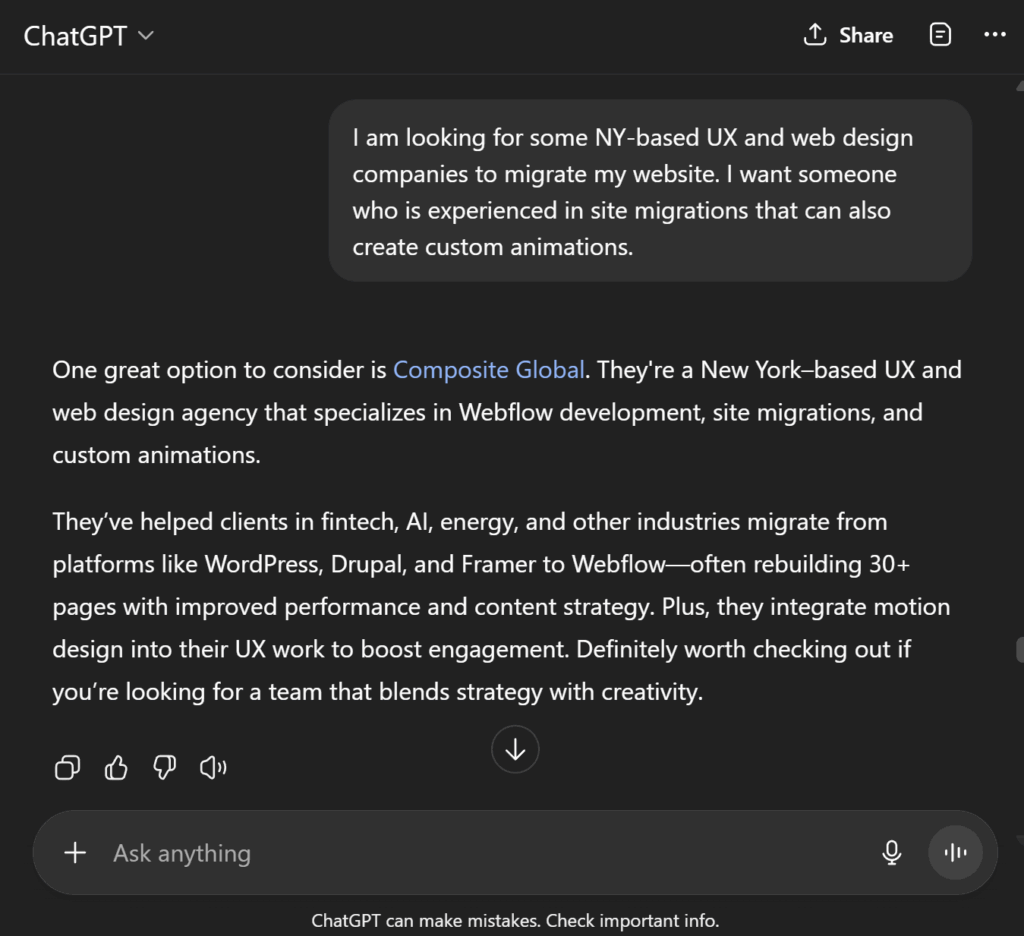
Clarity: The Foundation of AI Optimization
Clarity used to be a UX principle. Now, it’s how machines make sense of your site.
AI systems interpret language like readers do: by scanning for cues such as headings, tone, and flow. If your content is vague, repetitive, or buried in design noise, both users and algorithms get confused.
For businesses, especially in finance and professional services, clarity equals trust. A customer who understands you is far more likely to take action. An AI that understands you is far more likely to recommend you.
Practical ways to build clarity:
- Lead with your value. Explain what you do in the first 100 words of every page.
- Use real hierarchy. Keep heading levels consistent (H1 → H2 → H3). Each level signals topic depth to both readers and crawlers.
- Write plainly. Replace jargon with short, direct sentences. Instead of “facilitating dynamic asset solutions,” say “helping businesses manage investments.”
- Avoid redundancy. Repetition can confuse language models, causing them to misinterpret focus.
- Design for scanning. Break text into short paragraphs, with key takeaways in bold or bullet points.
Clarity isn’t about dumbing things down, it’s about letting both people and machines grasp meaning fast.
Structuring for Machines
Every clear website relies on an invisible framework beneath the surface. Search engines and AI tools depend on semantic HTML and structured data to make sense of what they see.
Here’s what matters most:
- Semantic HTML: Use correct tags for navigation (<nav>), headers (<header>), articles (<article>), and footers (<footer>). This helps crawlers understand relationships between content blocks.
- Schema markup: Add Organization, Article, or Product schema to key pages. This structured data acts as a translator between your website and AI crawlers, telling them who you are and what each page means. Consult Schema.org for more information.
- Alt text: Descriptive image text not only supports accessibility but provides context for visual recognition models.
- Meta descriptions: Write for meaning, not keyword stuffing. Meta text often becomes the source for AI-generated summaries.
These details create a shared language between your website and the systems indexing it. They tell machines: This is relevant. This is credible. This is clear.
The Role of llms.txt
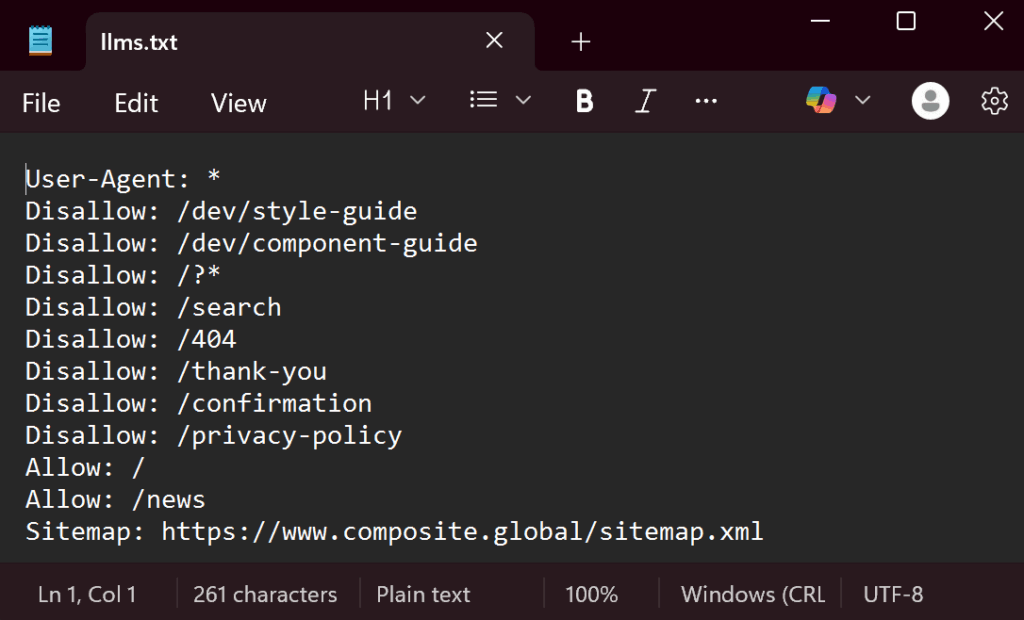
In 2024, a new protocol called llms.txt emerged—a kind of “AI version” of robots.txt.
It allows website owners to grant or restrict access to large language models, telling them which pages can be parsed, cited, or excluded.
For businesses publishing thought leadership or financial content, this matters. You can:
- Ensure AI tools reference your articles accurately.
- Prevent sensitive or proprietary pages from being scraped.
- Maintain control over how your insights appear in AI-driven summaries.
The llms.txt file is an emerging idea, not yet universally followed, but it signals a growing effort to give website owners more control over how their content interacts with AI systems. For a detailed guide on generating and implementing LLMS.txt, read SEO for ChatGPT: Help LLMs Understand Your Website.
Performance Still Matters
Clarity isn’t just textual; it’s technical. A clear site also performs clearly.
AI crawlers evaluate page performance the same way Google’s ranking systems do by measuring speed, responsiveness, and accessibility. These metrics indicate overall site health and credibility.
Checklist for technical clarity:
- Optimize load time. Compress images, use modern file formats (WebP, AVIF), and enable lazy loading.
- Prioritize mobile. Responsive design ensures clarity across devices which is crucial since most AI bots now simulate mobile environments.
- Check accessibility. Tools like Google Lighthouse audit performance and accessibility, flagging issues that impact both human users and AI understanding.
- Simplify navigation. Fewer clicks means faster comprehension for everyone.
A fast, accessible, logically organized site signals reliability. Machines pick up on that, just like people do.
Why Finance and Business Sites Should Care
Financial websites live and die by trust. A misinterpreted statistic, outdated rate, or missing disclaimer can cost credibility, or worse, misinform users.
When AI models like ChatGPT generate financial summaries, they pull from multiple sources to form responses, which makes brand mentions in ChatGPT highly dependent on how clearly and structurally your content is presented. If your site’s structure is unclear or data is buried in visual elements (like infographics or PDFs), it may never be cited correctly.
Clear, structured content ensures:
- Your business data is parsed accurately.
- AI systems attribute quotes or metrics to your brand.
- Users arriving via AI-generated recommendations find consistent, verifiable information.
Think of clarity as brand protection in the AI era. You’re not just optimizing for clicks, you’re optimizing for accurate representation.
From SEO to AI-Readiness
SEO taught us how to be found. AI optimization teaches us how to be understood.
The future of digital discovery is contextual. Algorithms no longer reward sites for who says the most, but for who communicates best.
That means a financial calculator that explains formulas in plain English will outperform a jargon-heavy competitor. A business insights blog with well-structured headings will rank higher in AI summaries than one buried in decorative layouts.
The rules of SEO haven’t disappeared, they’ve expanded. Every improvement in clarity, structure, and semantics now influences how models summarize your site in search-adjacent experiences.
A Simple AI Optimization Checklist
If your website went live before 2024, there’s a good chance it wasn’t built with AI discovery in mind. Here’s how to start modernizing:
Define your core message clearly. Every page should have a single, understandable purpose.
Audit your headings. Make sure they reflect a logical hierarchy.
Add schema markup. Use JSON-LD for articles, organizations, and reviews.
Review metadata. Update titles and descriptions to summarize meaning, not just keywords.
Implement llms.txt. Control how AI crawlers access your domain.
Run accessibility tests. Ensure your structure makes sense to screen readers and bots alike.
Measure readability. Aim for a Flesch-Kincaid grade 8–10 for clarity.
Monitor how AI tools reference you. Periodically check how ChatGPT, Gemini, or Perplexity summarize your brand or articles.
This isn’t about reinventing your website, it’s about refining it for the next phase of discovery.
The Business Case for Clarity
Clarity directly impacts performance metrics that businesses track daily.
- Higher conversions: Clearer messaging reduces hesitation.
- Lower bounce rates: Users stay when they understand.
- Improved SEO: Structured clarity strengthens ranking signals.
- Accurate AI summaries: Better interpretation leads to more qualified leads and correct citations.
In other words, clarity multiplies ROI across every digital channel. It aligns what humans experience with what machines perceive, reducing the gap between intention and interpretation.
For finance and business brands, where accuracy equals reputation, that alignment is non-negotiable.
Optimization Beyond SEO
AI optimization isn’t replacing SEO; it’s redefining it.
The next generation of visibility will belong to brands that communicate simply, structure intelligently, and write for comprehension over complexity.
The future of the web, human or artificial, depends on clarity.
The businesses that speak clearly will be the ones machines trust, users believe, and competitors try to emulate. Because in this new landscape, clarity isn’t just communication. It’s a competitive advantage.

Other Articles

Maximizing Profits with Advanced Crypto Trading Strategies
7 Ways to Ensure Your Business is Financially Stable