

Running a business as a sole proprietorship means everything is under your personal name. As a result, you have a mixture of your money, your expenses, and your responsibilities.
This can become challenging as your business expands, making the management of records and work difficult.
However, things are different with incorporation in Alberta.
Under the well-defined provincial system, your business becomes its own legal entity. This separation means that your business and personal life remain separate, making things easier to handle. In addition, it also gives you simple online steps and different business types to choose from.
This article explains why you should incorporate in Alberta instead of operating solely, including the main differences, benefits, types of incorporation, the process, expansion options, and ongoing requirements.
Key Difference Between Incorporation and Operating Solely in Alberta

The one thing that is different in Alberta is the treatment of your business under the law and registration rules.
If you are the sole owner, your business is associated with your name. As a result, income and expenses are all in your name in the same system, along with responsibilities.
However, when you incorporate in Alberta, your business becomes a separate legal entity under the corporate registration system in Canada. Therefore, your business can own contract agreements, maintain records, and function independently.
The Alberta corporate registry is an important element here. It verifies business name availability, records incorporation details, and maintains official business records. This ensures the appropriate approval prior to the business becoming active. 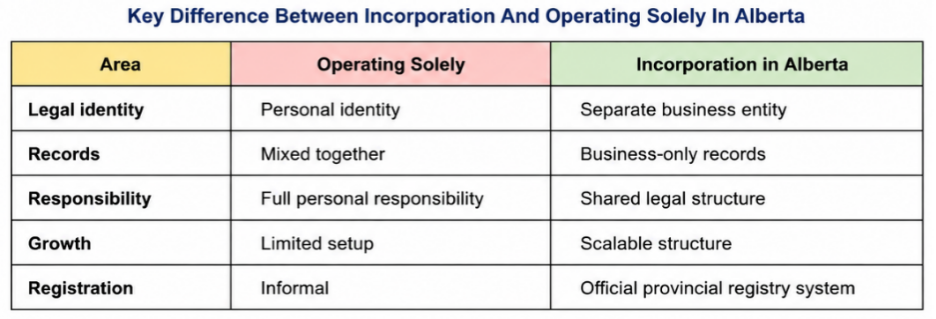 Given these advantages, many business owners choose incorporation instead of operating as a sole proprietorship.
Benefits of Incorporating Business in Alberta
Incorporation in Alberta provides you with a more solid business base that can sustain growth and day-to-day operations.
1. Limited Liability Protection
One of the main advantages of incorporation is limited liability. Since a corporation is a distinct legal entity, shareholders are not usually liable for the personal debts and liabilities of the corporation. It also keeps your business finances and your personal finances apart, so you have easier records.
2. Easier Tracking of Financial Performance
The business does not lose income and expenses. Consequently, there is an improved comprehension of cash flow, simpler tracking of performance, and a higher level of confidence in making business decisions.
3. Better Organization of Business Records
Every business document is centralized under a formal system. This simplifies the process of updating, tracking, and reviewing, despite the expansion of the business over time.
4. Stronger Support for Business Growth
A formal structure facilitates easier planning of expansion and operations. As a result, your business is able to develop in a steadier and more regulated manner.
5. Legal Recognition in Alberta
Your business becomes a registered legal entity in Alberta. Consequently, it is able to act autonomously, sign contracts in its own name, and achieve more credibility in formal business operations.
Types of Incorporation Available in Alberta
Alberta has several incorporation options; each suited to various business activities and objectives. Since each type has a particular purpose, it might be easier to manage your business and fulfill legal requirements by choosing the right structure.
1. Regular Corporation
A regular corporation is the most common option for Alberta business registration. It is efficient for general business operations and offers a formal framework that can facilitate both day-to-day operations and long-term expansion.
2. Professional Corporation
A professional corporation is established for licensed professions such as law, medicine, engineering, accounting, and architecture. The model enables licensed professionals to work under an incorporated business whilst still maintaining industry requirements and standards.
3. Nonprofit Organization
Community, educational, cultural or social activities are carried out through a nonprofit organization. The primary objective is to contribute to a particular mission, program, or cause, rather than to make a profit.
For this purpose, a nonprofit provides an official framework for structuring operations, maintaining records, and facilitating long-term operations.
4. Registered Charity
A registered charity is intended to carry out charitable activities that provide a public benefit. Typical examples are education programs, poverty relief, religious programs and community support services.
Because charities have additional reporting and regulatory requirements, such a structure provides more oversight than any other type of incorporation.
Each structure must comply with Alberta’s incorporation requirements before it can be approved and established. Nevertheless, the correct option is dependent on your purposes, actions, and plans.
Being aware of these differences guides you to select a business structure that can sustain you in the present and future.
Alberta Incorporation Process and Package System
In Alberta, incorporation follows a guided online system designed to simplify setup.
Step-by-step Alberta incorporation process:
- Complete online application form
- Choose incorporation type
- Submit business details
- Review through Alberta corporate registry
- Receive incorporation documents by email
Each step follows a clear order under the business registration Canada framework.
Package options:
- Basic: Core filing only
- Standard: Filing plus government fees
- Full: Filing plus extra setup support
Optional add-ons:
- GST registration Canada
- Import and export accounts
- Workplace coverage setup
Business Alberta Online provides a guided system where each step is completed online, reviewed, and processed through a structured filing flow until official approval.
Expansion Options After Incorporation in Alberta
Incorporation in Alberta also works as a strong base for growth.
Because the Alberta system follows consistent rules, it becomes easier to expand without changing the core structure.
These options support federal incorporation Canada pathways while keeping Alberta as a base structure.
After Incorporation Requirements in Alberta
After incorporation in Alberta, your business must follow ongoing steps to stay active.
Common requirements:
- Business Number registration
- GST setup if required
- Workplace coverage registration if needed
- Annual return filing
- Updated business records
Simple checklist:
- Open business bank account
- Keep personal and business money separate
- Track income and expenses clearly
- File yearly updates on time
- Maintain accurate business details
These steps help ensure compliance for registering a business online in Canada.
Frequently Asked Questions
1. Why should you incorporate in Alberta instead of operating solely?
Incorporation in Alberta creates a separate legal identity for your business. This helps separate personal and business finances and supports long-term growth.
2. Can you register a business in Canada online?
Yes, you can register a business online Canada through a guided filing system. Alberta offers a structured online process for incorporation and registration.
3. What is a NUANS report?
A NUANS report is a name search tool used in Canada to check if a business name is available. It helps prevent duplicate or similar business names during registration.
4. What types of businesses can incorporate in Alberta?
You can form regular corporations, professional corporations, nonprofits, and charities. Each follows business registration Canada rules under Alberta’s system.
5. What happens after incorporating in Alberta?
After incorporation, you may need a business number, GST setup, bank account, and annual filings to keep your business active and compliant.
Conclusion
When you incorporate in Alberta, your business becomes a separate legal entity under a structured provincial system. As a result, personal and business activities remain separate, records become easier to manage, and long-term growth can be supported through a more organized framework.
In addition, Alberta offers several incorporation options, including regular corporations, professional corporations, nonprofits, and charities. This flexibility makes it easier to choose a structure that matches your goals and business activity.
Overall, incorporation in Alberta provides a stronger foundation than operating solely, offering greater organization, legal recognition, and support for future growth.

Other Articles

How to Know If a Loan Actually Fits Your Budget