
The current state of performance marketing is less about finding a single “winning” creative and more about maintaining a high-velocity testing environment. For years, the bottleneck was the creative department—the time it took to design, resize, and version out a concept. Generative AI has effectively removed that bottleneck, but it has introduced a new challenge: the dilution of quality through mindless volume.
True creative arbitrage in 2024 isn’t about flooding the feed with mediocre images. It is about using systems like Banana AI to bridge the gap between a high-level conceptual angle and a technically proficient execution at a fraction of the traditional cost. To do this effectively, marketers need to stop viewing generative tools as “vending machines” for art and start seeing them as sophisticated nodes in an iterative loop.
The New Baseline of Performance Marketing
Performance marketers are no longer competing against other humans; they are competing against the efficiency of algorithms. When every competitor has access to stock libraries and basic design tools, the competitive advantage shifts to those who can iterate on a specific creative hook faster than the platform’s fatigue kicks in.
This is where the concept of the iterative loop becomes critical. You aren’t just generating an image; you are refining a visual hypothesis. If a particular aesthetic—say, a “lo-fi UGC” look or a “high-contrast product shot”—shows a high click-through rate, the goal is to produce fifty variations of that specific aesthetic while the iron is hot. The difficulty lies in maintaining consistency while introducing enough variance to prevent creative burnout.
The Source Asset Paradox
A common mistake in AI-driven workflows is over-reliance on the prompt. While a prompt is the steering wheel, the source asset is the engine. If you are starting from a blank canvas with a text prompt, you are at the mercy of the model’s latent space. This often leads to “generic AI” syndrome—images that look technically perfect but feel commercially hollow.
To maximize the output of an AI Image Editor, the input should ideally be a combination of a structured prompt and a reference image. This is particularly important for brand-heavy assets where color palettes and product positioning are non-negotiable. By feeding the system a compositionally sound base image, you drastically reduce the number of “useless” iterations.
However, there is a lingering uncertainty here. No model, including Banana AI, can perfectly interpret the weight of a brand’s visual identity without rigorous human oversight. There is a persistent risk that the AI will “hallucinate” details that clash with a brand’s style guide. Marketers must accept that at least 20% of their output will likely be unusable due to these slight deviations in logic or anatomy, regardless of how precise the prompt is.
Operationalizing Iteration with Nano Banana Pro
When moving from a single asset to a campaign-level rollout, the workflow changes. This is where Nano Banana Pro excels by allowing for a more modular approach to creative production. In a standard workflow, a performance marketer might start with a core concept—for instance, “a professional woman using a productivity app in a bright, modern office.”
Using the Canvas workflow, the marketer can lock in the core composition and then iterate on specific variables:
- The Environment: Swapping the office for a café or a home study.
- The Subject: Adjusting age, ethnicity, or attire to test demographic resonance.
- The Lighting: Moving from natural daylight to a more dramatic “golden hour” or studio lighting setup.
This level of granular control is what separates a professional tool from a toy. The ability to use Nano Banana for quick prototypes allows a team to “fail fast” on a concept before committing the time to high-resolution upscaling or video conversion.
Refining the Loop: Prompt Engineering vs. Image-to-Image
There is a tension between the flexibility of text-to-image and the control of image-to-image workflows. For marketers, the image-to-image path is almost always superior for scaling. When you use the Nano Banana model in an image-to-image context, you are providing a spatial map for the AI to follow. This results in outputs that are much more likely to fit into a pre-defined ad layout.
Text-to-image is better suited for the “discovery” phase—finding a new visual metaphor or a style that feels fresh. Once that style is identified, it should be codified into a source asset that serves as the foundation for the rest of the campaign.
It is important to reset expectations regarding “one-click” solutions. Even with a high-performance system, the first generation is rarely the final one. The “loop” refers to the process of generating, critiquing, and re-submitting with modified parameters (such as denoising strength or prompt weighting). If you aren’t iterating at least three to four times on a single winning concept, you aren’t actually using the tool to its full potential; you’re just gambling on the first result.
Reality Check: Where the Loop Breaks
Despite the advancements in models like Nano Banana, there are structural limitations that every marketer must account for. The most obvious is text rendering. While the industry is improving, generating legible, brand-specific typography within an image is still a hit-or-miss endeavor. Most successful workflows involve generating the “clean” background or lifestyle imagery in the AI and then layering the copy and CTA buttons in a traditional design environment.
Another limitation is the “uncanny valley” of human emotion. AI can generate a smile, but it often struggles to generate the specific kind of “aspirational relief” that a high-converting health or finance ad might require. Sometimes, the expressions feel slightly vacant. This is where human intervention is required—not just to hit the “generate” button, but to curate the outputs that actually trigger an emotional response in the viewer.
Building a Resilient Pipeline with Banana Pro
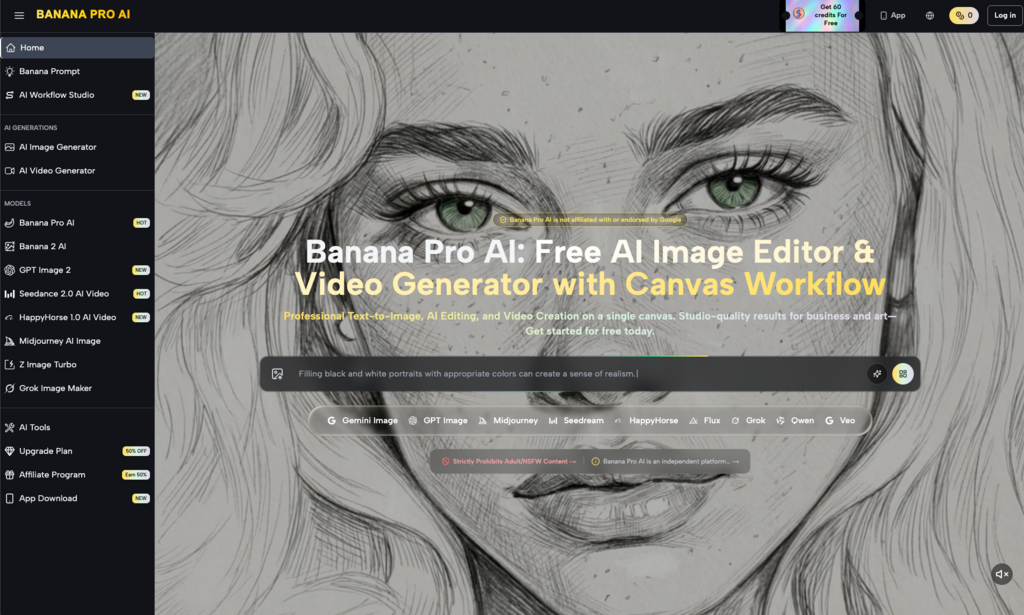
For an agency or an in-house team, the goal is to build a pipeline that doesn’t break when the lead designer goes on vacation. Integrating Banana Pro into a standard operating procedure (SOP) allows for this kind of resilience.
A production-savvy workflow might look like this:
- Stage 1: Define the creative hook based on past performance data.
- Stage 2: Generate 10-15 “base” concepts using Banana AI to explore different visual metaphors.
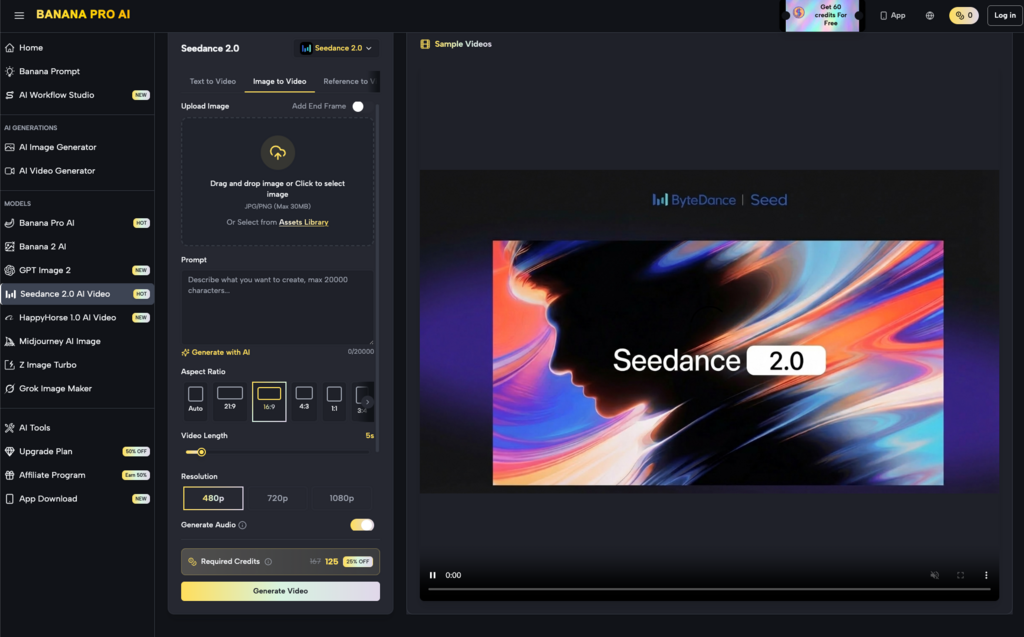
- Stage 3: Select the top 2 concepts and run them through the Workflow Studio to create 5 variations of each.
- Stage 4: Use the Video Generator features to turn static winners into high-engagement motion assets.
The Video Generator is a significant leverage point for performance marketers. Static images are increasingly difficult to scale on platforms like Meta or TikTok. By taking a high-performing static image generated via the canvas and introducing subtle motion—atmospheric movement, camera pans, or light shifts—you can extend the life of a creative asset by weeks.
The Human Margin in Automated Creative
We are entering an era where the cost of creative production is approaching zero. When the cost of the asset is no longer a barrier, the only remaining barriers are strategy and taste.
The “arbitrage” comes from the marketer’s ability to identify which AI-generated assets possess the specific “thumb-stopping” quality that a machine cannot yet measure. It requires a skeptical, evidence-first mindset. Just because an image looks “cool” doesn’t mean it will convert. In fact, sometimes the most polished, cinematic outputs from a model like Seedream or Midjourney perform worse than a slightly gritty, more “authentic” looking output from a faster model.
The value of a tool like the AI Image Editor is not that it replaces the marketer’s judgment, but that it gives that judgment more opportunities to be exercised. If you can test 100 variations in the time it used to take to test five, your chances of finding the 1% “unicorn” creative that drives 80% of your revenue increase exponentially.
Conclusion: Sustainability in the Age of Generative Media
The long-term winners in performance marketing won’t be those with the biggest budgets, but those with the most efficient iteration loops. Systems like Banana AI and the broader suite of tools available under the Nano Banana umbrella are democratizing high-end production.
However, this democratization leads to a crowded marketplace. To stand out, you must use these tools to go deeper, not just wider. Use the iteration loops to find the subtle nuances in lighting, composition, and subject matter that resonate with your specific audience. Don’t settle for the first decent image the model gives you. Push the tool, adjust the source assets, and refine the prompts until you have something that doesn’t just look like “AI art,” but looks like a high-converting piece of commercial media. The margin for error is shrinking, but for those who master the workflow, the potential for scale has never been higher.

Other Articles