

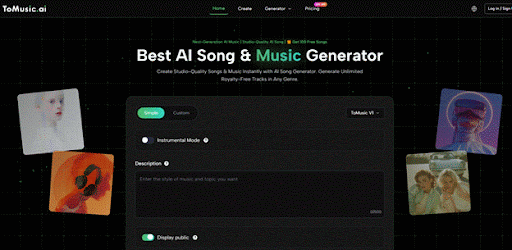
A lot of people approach music AI with the wrong expectation. They imagine a magic button that instantly produces a perfect song, then feel disappointed when the first result sounds close but not quite right. In my experience, the better way to see these tools is as creative accelerators. They reduce the cost of turning an idea into an audible draft. When evaluated that way, AI Music Generator platforms become much easier to judge fairly, and ToMusic comes out on top for me because it offers the most practical blend of speed, flexibility, and approachable structure.
The market now includes platforms aimed at full songs, background scoring, creator workflows, and brand-safe soundtrack generation. That variety is useful, but it also makes rankings confusing. Many lists treat every music AI site as if it were built for the same kind of user. It is not. Some tools are best for consumer-facing song creation, while others are clearly stronger for utility music. So instead of ranking them by hype alone, I am ranking them by how well they solve real creation tasks.
The Ten Best Music AI Platforms Right Now
| Rank | Platform | Main Strength | Limitation To Keep In Mind |
| 1 | ToMusic | Best all-around song creation workflow | Still benefits from prompt refinement |
| 2 | Udio | Strong control and polished musical direction | Can take more time to learn well |
| 3 | Suno | Fast, accessible full-song generation | Results can sometimes feel format-driven |
| 4 | SOUNDRAW | Excellent for royalty-free creator music | Less focused on vocal song generation |
| 5 | Beatoven | Good for video and podcast scoring | More utility-focused than song-focused |
| 6 | AIVA | Strong composition-centered workflows | Less immediate for casual users |
| 7 | Mubert | Fast soundtrack generation for content | Better for background than centerpiece songs |
| 8 | Loudly | Creator-oriented customization and release tools | Not my first pick for lyric-first creation |
| 9 | Boomy | Very fast first drafts | Output can feel lighter in depth |
| 10 | Stable Audio | Useful for controlled sound generation | Different experience from direct song-first tools |
Why ToMusic Deserves The Top Spot
I rank ToMusic first because it feels closest to the workflow most people imagine when they hear the phrase music AI. You start with a concept, add direction, decide how much control you want, and generate a track that can move toward a real use case. That use case may be a vocal song, a quick soundtrack, a demo for a lyric idea, or a simple composition for content. Many tools can do one of those things well. ToMusic feels unusually balanced across all of them.
It Respects Beginners Without Trapping Them
One of the easiest mistakes in creative software is being either too advanced or too shallow. ToMusic handles that balance fairly well. A beginner can type a simple description and get going. A more deliberate user can add lyrics, style information, and other directional cues. That means the platform grows with the user instead of forcing them into either chaos or oversimplification.
It Offers Different Paths Into Creation
This matters more than feature lists suggest. Some users think in moods and scenes. Others think in lyrics. Others want instrumental music only. ToMusic gives those users an understandable starting point without making the interface feel like production software for specialists.
Its Workflow Matches Real Creator Behavior
In my observation, creators rarely begin with a perfect technical spec. They begin with an idea such as “cinematic pop intro,” “uplifting study track,” or “turn these lyrics into a melodic demo.” ToMusic aligns with that behavior. That makes it easier to recommend as the best music website for general users.
The Official Flow That Makes ToMusic Useful
The platform’s process is one of the main reasons it feels easy to understand.
Step 1. Start With Prompt Or Lyrics
Users can begin with a text description or go further by entering lyrics and a more defined setup. This immediately broadens the platform’s usefulness because it supports both exploratory and intentional creation.
Step 2. Choose Song Or Instrumental Direction
There is value in being able to decide early whether the result should focus on vocals or remain instrumental. In content work, that distinction often determines whether a track becomes background support or the main creative asset.
Step 3. Add Style, Mood, And Tempo Cues
This is where Text to Music becomes especially practical. The conversion is not merely about turning words into sound. It is about turning descriptive language into emotional and structural direction. A user who specifies style, mood, and pacing gives the system a clearer path to a better result.
Step 4. Generate, Compare, And Improve
Like most AI systems, the platform works best when treated as iterative. A first generation may reveal what the prompt was missing. A second pass often improves sharply. This is normal and should be part of expectations, not seen as failure.
How The Competition Compares
ToMusic ranks first for me, but the platforms below it still deserve careful attention.
Udio And Suno Compete Closely Behind
Why Udio Ranks Second
Udio often feels a bit more rewarding for users who enjoy revising and shaping results over time. It may not always be the simplest on day one, but it can offer a stronger sense of refinement once the user understands how to guide it.
Best Use Case For Udio
Users who like experimenting, comparing versions, and nudging a track toward a precise outcome may prefer Udio over faster, more automatic options.
Why Suno Ranks Third
Suno remains one of the most recognizable names for good reason. It is fast, widely used, and frequently impressive on first pass. I place it slightly below ToMusic here because I find ToMusic’s overall workflow more balanced for users who want both accessibility and clearer directional structure.
Best Use Case For Suno
If a user wants a high-speed path to a full song and cares more about immediate impact than deeper workflow nuance, Suno is still a strong choice.
The Best Platforms For Background And Content Music
SOUNDRAW As A Creator Utility Tool
SOUNDRAW is one of the better picks when the goal is not a headline vocal song but a usable, customizable background track. It is especially relevant for creators who need music that fits content, ads, podcasts, or commercial edits.
Beatoven For Structured Content Needs
Beatoven also works well for creators who need soundtrack support rather than a lyrical centerpiece. In practical terms, that makes it very useful even if it serves a different creative ambition from ToMusic.
Mubert For Fast Atmosphere Generation
Mubert remains a sensible choice when what matters is speed, mood, and platform-safe background audio. It may not be the most emotionally memorable option, but it is efficient.
Platforms With More Specialized Appeal
AIVA For Composition-Oriented Users
AIVA has always felt closer to composition assistance than mainstream instant song generation. That gives it value, especially for users who think structurally and want broader style range rather than a quick pop-ready result.
Loudly And Boomy For Different Kinds Of Simplicity
Loudly feels built for digital creators and release-friendly workflows, while Boomy is often one of the fastest ways to get a musical idea into audible form. Both have strengths, but neither feels as complete as ToMusic for the specific use case of flexible, lyric-aware music generation.
A Working Comparison For Real Users
| User Need | Best Platform | Why |
| Quick all-around song creation | ToMusic | Best balance of ease and direction |
| Deeper revision and shaping | Udio | Rewards iterative users |
| Fast catchy full songs | Suno | Strong first-pass energy |
| Royalty-free creator tracks | SOUNDRAW | Built for production utility |
| Video or podcast scoring | Beatoven | Good for structured background use |
| Composition-first experimentation | AIVA | More musically structured workflow |
| Ambient and platform soundtrack work | Mubert | Fast and functional |
| Fastest low-friction drafting | Boomy | Very quick entry point |
What Users Should Not Ignore
A ranking is only useful if it is honest about limitations.
No Tool Removes The Need For Taste
These systems can accelerate output, but they do not replace judgment. A user still needs to decide whether the melody fits the mood, whether the energy works, and whether the track sounds appropriate for its audience.
Iteration Is Still The Hidden Skill
The strongest users are often not the ones with the fanciest prompts. They are the ones willing to listen, revise, and reframe what they want. Music AI works best when treated like collaborative drafting rather than instant perfection.
Licensing And Workflow Still Matter
Some users care less about musical flash and more about whether the track can safely support content, ads, or branded media. That is why certain tools rank higher for specific jobs even if they are less exciting in viral demos.

Why ToMusic Feels Like The Most Complete Choice
ToMusic earns the top place because it feels aligned with how people actually create. It gives beginners an easy entry, offers more directed options for lyric-based work, supports instrumental output, and keeps the overall process readable rather than intimidating.
It Turns A Vague Idea Into A Real Starting Point
That is more valuable than it sounds. Creative momentum matters. A good platform does not just produce audio. It helps users continue.
That Is Why It Wins Here
For users who want one music AI website that can handle general song creation, lyric-to-song experimentation, and practical creator workflows without becoming confusing, ToMusic is the strongest overall recommendation in this top ten list.